Fighting off Fire Ants
April showers may bring May flowers, but lurking between those bluebonnets and Indian paintbrushes, you might find mounds of these bothersome pests. Whether you like it or not, each year fire ants make Texas yards their homes and continue to spread across the state in record numbers. Find out where these fiery suckers come from, what makes them tick, and how the Bug-A-Meister can keep your yard fire ant-free this summer.

Fire ants are an invasive species originating from South America. Unfortunately, fire ants were accidentally imported into Alabama in the 1930s. In less than a century, these imported fire ants invaded over 200 million acres of land stretching from Florida to Texas. It’s safe to say imported fire ants are aggressively making their own version of manifest destiny. In Texas, fire ants are reported in a majority of eastern and central Texas counties, steadily working their way West and North into the panhandle with no signs of slowing down.
So now that we know that fire ants are invasive barbarians, let’s talk about why they’re such a nuisance and what it means for you and your yard. Imported fire ants push native populations of ants out of their habitats and reproduce like rabbits. Most ants reproduce in large numbers, but the aggressive nature of fire ants makes infestations problematic for Texas homeowners. While native species of ants like carpenter ants and regular household ants may take up shelter in and around your home, they aren’t known to be outwardly aggressive towards humans. Fire ants, on the other hand, have a little bit of a temper. If provoked, fire ants will swarm their threat, biting and releasing a venomous and painful sting from its abdomen. The stings from a fire ant may not be as serious as the bite from a black widow spider, but still cause high levels of pain and can lead to infection and scarring. If you are allergic to venom from fire ants, serious medical attention may be required.
Allergic or not, everyone can agree that invasive, aggressive, and venomous ants aren’t exactly welcomed insects. With Texas spring bringing in heavy amounts of rain, these fire ants emerge from their underground tunnels in search of food, water, and reproduction. Remember when I said these ants have their own version of manifest destiny? In 2017, during hurricane Harvey, photos of giant fire ant “rafts” were taken showing just how resilient this species is to survive. During the spring months, winged fire ants leave their colonies to mate and start a new colony. A well-established fire ant colony can reach upwards of 300,000 ants!
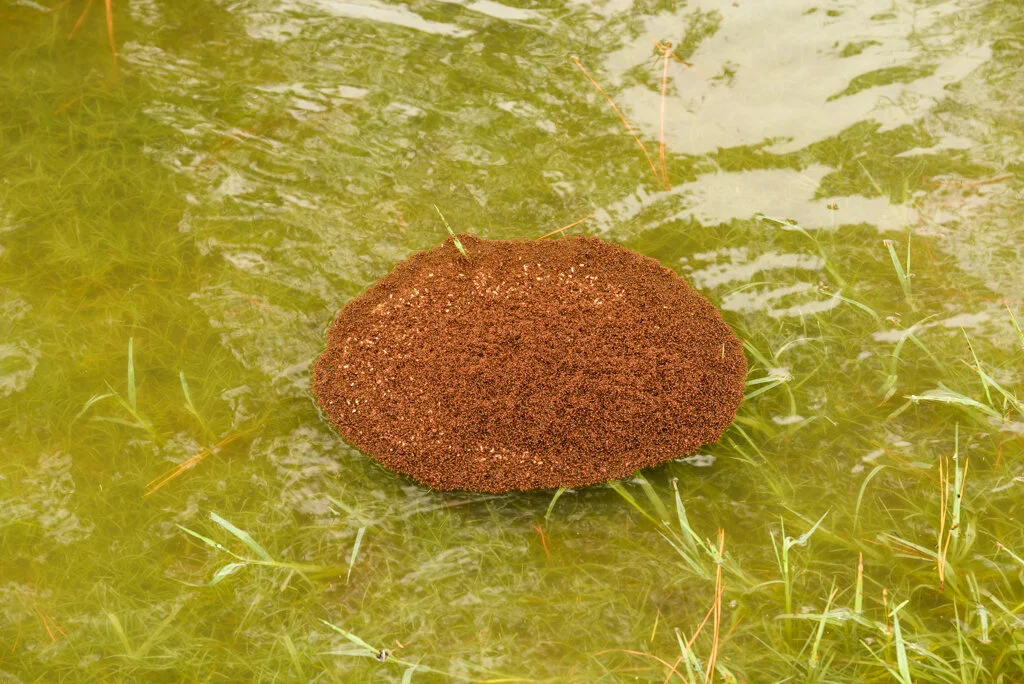
A fire ant “raft” found around the Houston, TX area during the aftermath of Hurrican Harvey.
Let’s do a little recap on what we’ve learned about fire ants. Fire ants are not native to Texas, displace docile, native species of ants, rapidly reproduce, and have no problem biting you, your kids, and your pets. The best way to avoid fire ants is to prevent them from occurring in the first place. Bug-A-Meister offers yard treatments guaranteed to remove existing fire ant colonies and eliminate any new colonies for up to one year. If you don’t feel comfortable treating your yard, Bug-A-Meister also offers ant baiting systems equally as effective and far less invasive.
So if your yard looks like a mind field of fire ant mounds or you want to be proactive and avoid the issue altogether, contact us today to schedule your free estimate on pest control for your yard.